Travelling with a food allergy: plane, hotel, abroad
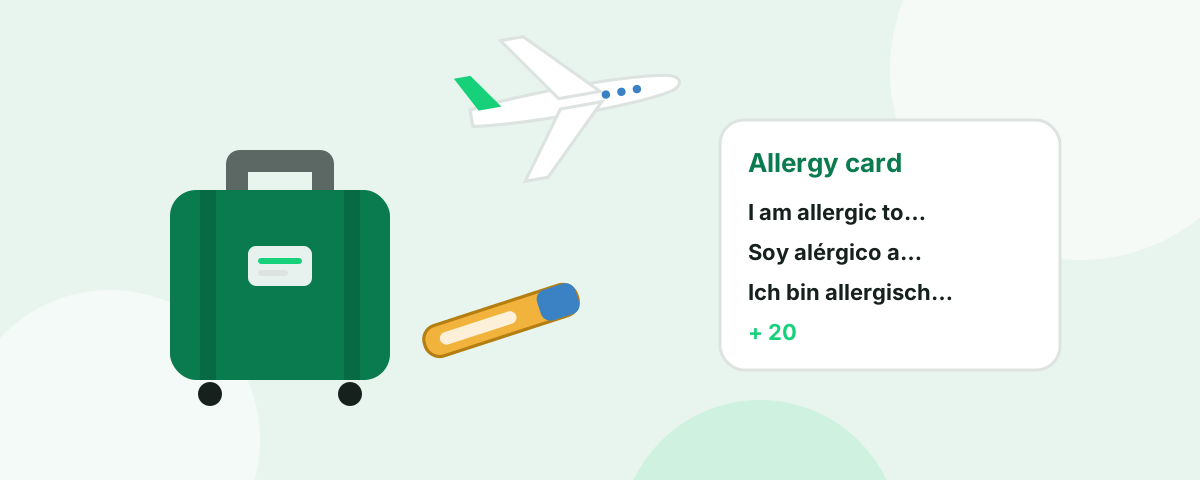
Going on holiday with a food allergy is entirely possible: it just takes a little more preparation than for others. The three key points are your medicines, the language and the labels. Here is how to get organised, from departure to return.
Before you leave
- See your doctor or allergist a few weeks before you leave. Renew your prescriptions, check the expiry date of your adrenaline pens and ask for a medical certificate, in English if you are going abroad.
- Take enough medicine for the whole stay, with some extra in case of delays. Keep it in its original packaging.
- Note the emergency numbers of the country (112 works throughout the European Union) and the address of the hospital closest to where you are staying.
- Check your travel insurance: it must cover medical care and possible repatriation.
- Prepare your allergy card in the local language, on paper and on your phone.
On the plane
- Medicines travel in the cabin, never in the hold: your adrenaline pen must stay with you throughout the flight. Keep your prescription or medical certificate to hand for the security check, and ask your airline and the airport about the rules for liquid and injectable medicines.
- Tell the airline when you book. Rules vary from one airline to another: ask what it can do (an announcement on board, priority boarding to clean your seat…). None can guarantee an allergen-free plane.
- Bring your own meal and snacks: it is the safest option. Airlines’ special meals do not necessarily cover all your allergens.
- Wipe the tray table and armrest with a wet wipe when you sit down.
At the hotel or in a rental
- For a hotel with a restaurant, write before you arrive to explain your allergies and ask how the kitchen works.
- A rental with a kitchen lets you control your meals: it is often the simplest solution, especially with a child.
- At a breakfast buffet, serve yourself first, before the utensils move from one dish to another.
Making yourself understood abroad
- Show your allergy card to the waiter, in their language: it clearly states what you cannot eat, including traces. In askadèle, it is available in more than 20 languages (see the translated allergy card).
- Keep two or three phrases to hand: "I am allergic to…", "Is there… in this dish?". askadèle’s travel mode shows them in large print and reads them aloud in the local language.
- Choose simple dishes: sauces, shared fryers and desserts are the riskiest.
Reading labels from another country
- In the European Union, the rules are the same everywhere: the 14 allergens are highlighted in the ingredients list (in bold, for example), and restaurants must be able to inform you. Only the language changes.
- Elsewhere, the list of allergens that must be declared is different. In the United States, 9 major allergens are mandatory: milk, eggs, fish, crustaceans, tree nuts, peanuts, wheat, soy and sesame (since 2023). Celery, mustard, lupin and molluscs are not on the list. In Canada, there are 11 priority allergens, including mustard and sulphites, but not celery or lupin.
- An allergen that is not mandatory can therefore hide behind "spices" or "flavourings". If in doubt, do not eat the product.
What askadèle can do for you
- Travel mode: choose your destination, and the app prepares your allergy card in the right language, useful phrases (to show or to listen to) and a "before you leave" checklist.
- The allergy card in more than 20 languages, to show the waiter or print, with a QR code that displays it in the language of their phone.
- Product scanning, in France and abroad: askadèle flags a product sold outside Europe and the allergens that country does not require to be declared.
- Restaurants that publish their allergens, in more than 40 towns in France.
- The emergency plan to print, for the holiday camp, the activity centre or the family looking after your child.
Scanning, the verdict, the allergy card and child mode are free and need no account.
In case of a reaction
Follow the emergency protocol prescribed by your doctor and call the country’s emergency number (112 in the European Union). This guide gives general guidance: it does not replace the advice of your doctor or allergist.
This guide gives general pointers. It does not replace the advice of your doctor or allergist, or reading the label. In the event of a severe reaction: use the prescribed emergency treatment and call 15 (French emergency medical service) or 112.
askadèle checks your products for you
Open the appScan a barcode: the app compares the ingredients with your allergies. Free, no sign-up.
Find a restaurant that publishes its allergens
GrenobleParisMarseilleLyonLe HavreReimsRennesAngersBordeauxDeauvilleLilleNantes
Sources
- Règlement (UE) n° 1169/2011 concernant l'information des consommateurs sur les denrées alimentaires (INCO) — EUR-Lex
- Médicaments en avion — Lyon Aéroports
- Food Allergies : the major food allergens — FDA
- Allergènes alimentaires les plus courants — Santé Canada
Read next
 Eating out with a food allergy: the practical guideChoosing a restaurant, what the law requires, the questions to ask the waiter and the pitfalls in the kitchen: everything you need to eat out with peace of mind.
 Food allergy at school: getting ready for the new school year and the PAIPAI, emergency kit, school canteen, school trips: the checklist for a calm start to the school year when your child has a food allergy.
 Peanut allergy: where are peanuts hiding?The names peanuts go by on labels, the dishes and cuisines where they hide, and good everyday habits at home and in restaurants.